|
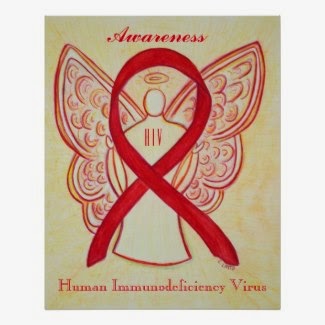
| Acquired Immunodeficiency Syndrome (AIDS) Awareness Ribbon |
Key Points about HIV & AIDS
-HIV is the virus that causes HIV infection.
AIDS is the most advanced stage of HIV infection.
-HIV is spread through contact with the blood, semen, pre-seminal fluid, rectal fluids, vaginal fluids, or breast milk of a person infected with HIV. In the United States, HIV is spread mainly by having anal or vaginal sex or sharing drug injection equipment with a person infected with HIV.
-The use of HIV medicines to treat HIV infection is called antiretroviral therapy (ART). ART involves taking a combination of HIV medicines (called an HIV regimen) every day.
-ART can’t cure HIV infection, but it can help people infected with HIV live longer, healthier lives. HIV medicines can also reduce the risk of transmission of HIV.
What is HIV/AIDS?
 |
| Support HIV Awareness Red Ribbon Angel Magnet |
AIDS stands for acquired immunodeficiency syndrome. AIDS is the most advanced stage of HIV infection.
HIV attacks and destroys the infection-fighting CD4 cells of the immune system. Loss of CD4 cells makes it difficult for the body to fight infections and certain cancers. Without treatment, HIV gradually destroys the immune system and advances to AIDS.
How is HIV spread?
HIV is spread through
contact with certain body fluids from a person infected with HIV.
These body fluids include:
These body fluids include:
* Blood
* Semen
* Pre-seminal fluid
* Vaginal fluids
* Rectal fluids
* Breast milk
* Semen
* Pre-seminal fluid
* Vaginal fluids
* Rectal fluids
* Breast milk
The spread of HIV from
person to person is called HIV transmission. The spread of HIV from an
HIV-infected woman to her child during pregnancy, childbirth, or breastfeeding
is called mother-to-child transmission of HIV.
In the United States, HIV is spread mainly by having sex with or sharing drug injection equipment with someone who is infected with HIV. To reduce your risk of HIV infection, use condoms correctly and consistently during sex, limit your number of sexual partners, and never share drug injection equipment.
Mother-to-child transmission is the most common way that children become infected with HIV. HIV medicines, given to HIV-infected women during pregnancy and childbirth and to their babies after birth, reduce the risk of mother-to-child transmission of HIV.
You can’t get HIV by shaking hands or hugging a person infected with HIV. And you can’t get HIV from contact with objects such as dishes, toilet seats, or doorknobs used by a person with HIV.
In the United States, HIV is spread mainly by having sex with or sharing drug injection equipment with someone who is infected with HIV. To reduce your risk of HIV infection, use condoms correctly and consistently during sex, limit your number of sexual partners, and never share drug injection equipment.
Mother-to-child transmission is the most common way that children become infected with HIV. HIV medicines, given to HIV-infected women during pregnancy and childbirth and to their babies after birth, reduce the risk of mother-to-child transmission of HIV.
You can’t get HIV by shaking hands or hugging a person infected with HIV. And you can’t get HIV from contact with objects such as dishes, toilet seats, or doorknobs used by a person with HIV.
What is the treatment for HIV?
The use of HIV
medicines to treat HIV infection is called antiretroviral therapy (ART). ART
involves taking a combination of HIV medicines (called an HIV regimen)
every day. (HIV medicines are often called antiretrovirals or ARVs.)
ART prevents HIV from multiplying and reduces the level of HIV in the body. Having less HIV in the body protects the immune system and prevents HIV infection from advancing to AIDS.
ART can’t cure HIV, but it can help people infected with HIV live longer, healthier lives. ART also reduces the risk of HIV transmission.
ART prevents HIV from multiplying and reduces the level of HIV in the body. Having less HIV in the body protects the immune system and prevents HIV infection from advancing to AIDS.
ART can’t cure HIV, but it can help people infected with HIV live longer, healthier lives. ART also reduces the risk of HIV transmission.
What are the symptoms of HIV/AIDS?
Soon after infection
with HIV, many people have flu-like symptoms, such as fever, headache, or rash.
The symptoms may come and go for a month or two after infection.
After this earliest stage of HIV infection, HIV continues to multiply but at very low levels. More severe symptoms of HIV infection, such as chronic diarrhea, rapid weight loss, and other signs of opportunistic infections, generally don’t appear for many years. (Opportunistic infections are infections and infection-related cancers that occur more frequently or are more severe in people with weakened immune systems than in people with healthy immune systems.)
Without treatment, HIV can advance to AIDS. The time it takes for HIV to advance to AIDS varies, but it can take 10 years or more.
After this earliest stage of HIV infection, HIV continues to multiply but at very low levels. More severe symptoms of HIV infection, such as chronic diarrhea, rapid weight loss, and other signs of opportunistic infections, generally don’t appear for many years. (Opportunistic infections are infections and infection-related cancers that occur more frequently or are more severe in people with weakened immune systems than in people with healthy immune systems.)
Without treatment, HIV can advance to AIDS. The time it takes for HIV to advance to AIDS varies, but it can take 10 years or more.
HIV transmission is possible at any stage of HIV infection—even if an HIV-infected person has no symptoms of HIV.
How is AIDS diagnosed?
The following criteria
are used to determine if a person infected with HIV has AIDS:
The person’s immune system is severely damaged
as indicated by a CD4 count of less than 200 cells/mm3. A CD4 count measures the number of CD4 cells in a sample of
blood. The CD4 count of a healthy person ranges from 500 to 1,600 cells/mm3.
The person has one or more opportunistic
infections.
How can I learn more about HIV/AIDS?

Support AIDS Awareness Red Ribbon Angel
Read this
webpage: How Do You Get HIV OR AIDS?
-From the Centers for Disease Control and Prevention (CDC):
HIV Basics
-From the Centers for Disease Control and Prevention (CDC):
HIV Basics
-From the National Institute of Allergy and
Infectious Diseases (NIAID):
Understanding HIV/AIDS
Understanding HIV/AIDS
The above information is from the National Institute for Health (NIH). Read more about HIV and AIDS on the NIH website at http://aidsinfo.nih.gov/education-materials/fact-sheets/19/45/hiv-aids--the-basics#
Learn how to use this art for fundraisers and awareness on DonnaBellas Angels.
Shop the Awareness Gallery Store for AIDS, HIV, and other causes. There are gifts with HIV & AIDS awareness text and other red awareness ribbon angel only gifts.
Learn how to use this art for fundraisers and awareness on DonnaBellas Angels.
Shop the Awareness Gallery Store for AIDS, HIV, and other causes. There are gifts with HIV & AIDS awareness text and other red awareness ribbon angel only gifts.